
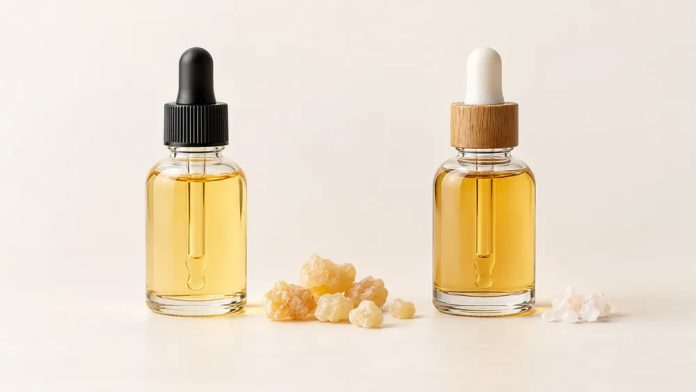

The choice between a frankincense tincture vs spagyric elixir starts with a practical question: what is actually in the bottle? An alcohol-free liquid and an alcohol-containing spagyric elixir may look similar, but their ingredients and preparation differ. This guide shows you how to check those
differences without assuming that extra processing makes a product more potent. HerbEra describes its frankincense liquid as alcohol-free, a claim worth checking against the current label before purchase.
Short answer: A spagyric label describes a method of preparation, not an alcohol-free standard. If avoiding alcohol is your priority, inspect the complete ingredient list and ask for the finished product’s alcohol content when the label does not state it.
What is the difference between the two preparations?
A conventional liquid frankincense extract uses a solvent to draw substances from Boswellia resin. A spagyric preparation generally adds a further step: mineral material recovered from the processed plant or resin residue is incorporated into the extract. Neither name tells you everything about
the finished liquid.
Alcohol-free liquid extract
An alcohol-free frankincense product uses a non-alcoholic finished formula, according to its label claim. The maker should identify the liquid base and other ingredients. The word “tincture” is often associated with alcohol extraction, but product names are not a reliable substitute for an
ingredient list or a statement about residual alcohol.
Spagyric elixir
Spagyric methods commonly involve extraction, processing the remaining material to obtain mineral salts, and combining those salts with the liquid. Recipes and finished formulations vary. One commercially listed frankincense spagyric elixir declares frankincense resin, alcohol, purified water, and
mineral salts. That example illustrates why “spagyric” should not be read as “alcohol-free.”
A published chemical assessment examined spagyric preparations made from a different botanical, devil’s claw. It helps explain the processing method and the value of chemical testing. It does not establish that a frankincense spagyric elixir performs better than a non-spagyric frankincense
extract.
How should you compare the labels?
Compare the finished products, not just the words on their front panels. For an alcohol-free frankincense liquid extract and a spagyric elixir, the most useful details are the liquid base, botanical identity, serving information,
and batch-specific testing.
| Label detail | Alcohol-free frankincense liquid | Spagyric frankincense elixir | What to verify |
|---|---|---|---|
| Liquid base | Should disclose its non-alcoholic ingredients | May contain alcohol and water | Read the complete ingredients, not the product name |
| Alcohol status | Check how the alcohol-free claim is supported | Check whether alcohol appears in the finished formula | Request a finished-product result if strict avoidance matters |
| Botanical identity | Frankincense resin from a Boswellia species | Frankincense resin from a Boswellia species | Look for the species and resin as the plant material |
| Added mineral salts | Not implied by the format | May be part of the spagyric method | Check whether salts are declared and quantified |
| Serving information | May use drops or milliliters | May use drops or droppers | Look for a measured volume per serving |
| Chemical profile | Depends on raw material and extraction method | Depends on raw material and processing method | Ask which compounds were measured in the finished batch |
| Evidence of superiority | Not established by an alcohol-free claim | Not established by the spagyric name | Look for a direct, relevant comparison of finished formulations |
HerbEra’s editorial position is to judge extra processing by disclosed ingredients and verifiable test results, not by language suggesting that a more elaborate process must produce a better supplement.
Does spagyric processing remove alcohol?
No. Adding mineral salts does not, by itself, remove alcohol from a liquid extract. Some spagyric formulas use alcohol as a solvent and retain it in the finished product. Others may use different methods. The only dependable answer for a specific bottle comes from its current ingredients and
finished-product specifications.
Ingredient list first
Find the full ingredient list, including the liquid base. If it lists ethanol, ethyl alcohol, grain alcohol, or organic alcohol, do not assume that adding the drops to water makes the product alcohol-free. Dilution changes concentration in the glass but does not establish that the alcohol is
absent.
Finished-product data when needed
If your routine requires strict alcohol avoidance, ask the company what “alcohol-free” means for that product and whether it has a batch-specific residual ethanol result. Also ask whether alcohol was used during extraction and later removed. Those are different questions. A statement about the
manufacturing solvent does not automatically describe the final bottle.
Do not borrow an alcohol threshold from rules for wine, cosmetics, or medicines and apply it to supplements worldwide. Labeling standards differ by product category and country. If the seller cannot answer a question that matters to you, leave the alcohol status unresolved rather than guessing.
Do mineral salts make a spagyric elixir stronger?
The presence of mineral salts shows a formulation difference. It does not establish greater potency, better absorption, or a better user experience. To assess a specific claim, you need to know which salts are present, their amounts per serving, and what outcome the claim refers to.
Chemical change is not a measured benefit
Processing can change a product’s composition. A laboratory comparison could measure its mineral content and a chemical profile of the resin extract. Those results would tell you what is present, but they would not alone show that the finished elixir has a superior effect in people.
Product-specific evidence matters
A convincing superiority claim would require a relevant comparison of clearly identified formulations under comparable conditions. The Boswellia species, extraction method, serving amount, and measured compounds should be reported. A study of another herb, an isolated compound, or a differently
prepared Boswellia product cannot settle the comparison for two bottles on a shelf.
Frankincense comes from several Boswellia species, and their chemical profiles can differ. A label that says only “Boswellia spp.” gives less identity detail than one naming a species. Even a named species does not reveal how much of any measured compound is in the finished serving.
Which product details are most useful before buying?
Start with the details that answer your actual question: alcohol status and formulation. Then check whether both products provide enough information to compare their contents and price fairly.
Measured serving size
“One dropper” is less precise than a stated volume because droppers and fill levels vary. If one bottle lists drops and the other lists milliliters, do not assume a universal drop-to-milliliter conversion. Ask the maker for its measured serving volume.
Extract and marker information
An extract ratio describes a relationship between starting material and extract. It does not state the amount of boswellic acids or other compounds in each serving. If a brand highlights a marker, look for the named test method, result, units, and batch identification. A marker result is a
composition detail, not proof of a particular outcome.
Batch and quality records
A certificate of analysis is most informative when it identifies the same lot printed on your bottle. Useful fields include the laboratory, test date, botanical identity, measured compounds, and relevant contaminant results. A generic statement such as “lab tested” does not say which batch or
tests it covers.
Cost per measured serving
Compare the price against the number of labeled servings, not bottle size alone. A higher-priced elixir may reflect a different manufacturing process, but its price does not demonstrate greater value for your purpose. If serving volume is missing, cost per serving remains uncertain.
Checklist: choosing a frankincense liquid when alcohol matters
Use this checklist for the exact bottle you plan to buy. Product pages can change, so confirm important details on the current label or directly with the maker.
Check the finished ingredients
Read the full list, including solvents, sweeteners, and added salts. Do not infer alcohol status from “tincture” or “elixir.”
Clarify the alcohol claim
Ask whether the finished product contains measurable ethanol if strict avoidance is important. A solvent used earlier in production is a separate issue to clarify.
Identify the resin
Look for Boswellia species information and confirmation that the product uses resin. A broad botanical name may leave the exact species unclear.
Measure the serving
Find the serving volume in milliliters or ask for it. Avoid comparing different dropper sizes as though they were identical.
Request batch evidence
Match any test document to the lot number on the bottle. Check what the laboratory actually measured.
Question superiority language
Ask for evidence on the finished formulation when a seller claims that its process improves performance. Processing steps alone cannot answer that question.
Review personal constraints
If you take medication, are pregnant or breastfeeding, or must avoid alcohol for another reason, discuss the complete product label with a qualified healthcare professional before adding either supplement.
FAQ
Is every spagyric elixir alcoholic?
No. “Spagyric” describes a preparation approach, not a fixed alcohol content. Check the finished ingredients and ask for product-specific data.
Is an alcohol-free tincture a contradiction?
Not necessarily. Sellers sometimes use “tincture” for liquid botanical extracts without alcohol. The formulation matters more than the name.
Do added mineral salts prove greater potency?
No. They indicate a formulation difference. Greater potency or improved absorption would need separate, relevant evidence.
Can I compare the products by counting drops?
Only if each maker provides a reliable volume per serving. Drop size can vary between liquids and droppers.
Does a Boswellia study apply to every frankincense liquid?
No. Species, extraction method, composition, and serving amount may differ from the studied product.
What if the alcohol content is not disclosed?
Ask the maker for finished-product information. If strict avoidance matters and the answer remains unclear, do not assume the liquid is alcohol-free.
Glossary
Boswellia
A genus of trees whose resin is sold as frankincense.
Resin
The aromatic material collected from a Boswellia tree and used as the starting material in these products.
Solvent
A liquid used to extract substances from raw material.
Spagyric
A preparation approach that separates and later recombines extracted material, often with recovered mineral salts.
Mineral salts
Inorganic material that may be recovered during spagyric processing and added to the finished liquid.
Marker compound
A measured substance used to describe or check an extract’s chemical profile.
Residual ethanol
Ethanol remaining in the finished product after manufacturing.
Certificate of analysis
A document reporting specified laboratory results for an identified sample or batch.
Conclusion
If alcohol avoidance is the deciding factor, verify the finished formula before considering claims about spagyric processing. Mineral salts and extra steps distinguish a preparation, but they do not establish that it is alcohol-free or superior.
Sources Used
- Frankincense liquid product description and alcohol-free claim - herb-era.com/products/frankincense-tincture
- Frankincense spagyric elixir ingredients and preparation description - earthspiralapothecary.com/products/frankincense-spagyric-elixir
- Quality assessment of commercial spagyric devil’s claw tinctures - pmc.ncbi.nlm.nih.gov/articles/PMC6630815
- Guidance on substantiating dietary supplement claims - fda.gov/regulatory-information/search-fda-guidance-documents/guidance-industry-substantiation-dietary-supplement-claims-made-under-section-403r-6-federal-food
- Consumer information on dietary supplement labels and quality - ods.od.nih.gov/factsheets/DietarySupplements-Consumer
- Review of compounds and species differences in Boswellia resin - pmc.ncbi.nlm.nih.gov/articles/PMC3847453
